
The problem: one controller, any building
Heating, ventilation and air conditioning (HVAC) use a large share of a building's energy; the challenge organisers cite roughly 40 to 60 percent. Most published controllers are built and tested on one building. A building owner wants something else: a controller that works on their building, which nobody tuned it for.
The Smart Buildings Challenge, part of NeurIPS 2026, asks exactly that. Entrants write one control policy. It has to run buildings it has never seen, in weather it has never seen, with no per-building tuning. Each simulated month is 8,640 five-minute steps, and every step is scored on three things: comfort for the people inside (weighted most), energy cost and carbon.
What we did
A controller you can read. Instead of a large learned model, we started from a small rule controller, the kind of logic a building engineer could follow line by line. It reads the building's own description (which rooms hang off which air handler, the schedule, the comfort band) and reacts to room temperatures and the weather outside. Nothing in it depends on knowing which building it is in.
A tuning plan written before any tuning. The controller has dials: how hard to push the fans, how quickly to open dampers and reheat valves, and so on. We chose to tune 14 of them, plus one on/off switch, and we wrote down the whole procedure before the first run: which buildings to tune on, how the search moves, when it stops and which follow-up tests we would run. Researchers call this pre-registration. It stops you from quietly trying things until something looks good.
Two buildings locked away. The kit ships six practice buildings, each with five weather locations, 30 combinations in all. We tuned on four buildings and set two aside without looking at them. The search tried 75 settings over 924 simulated months. Then we froze the dials and ran the two locked-away buildings once.
What we found
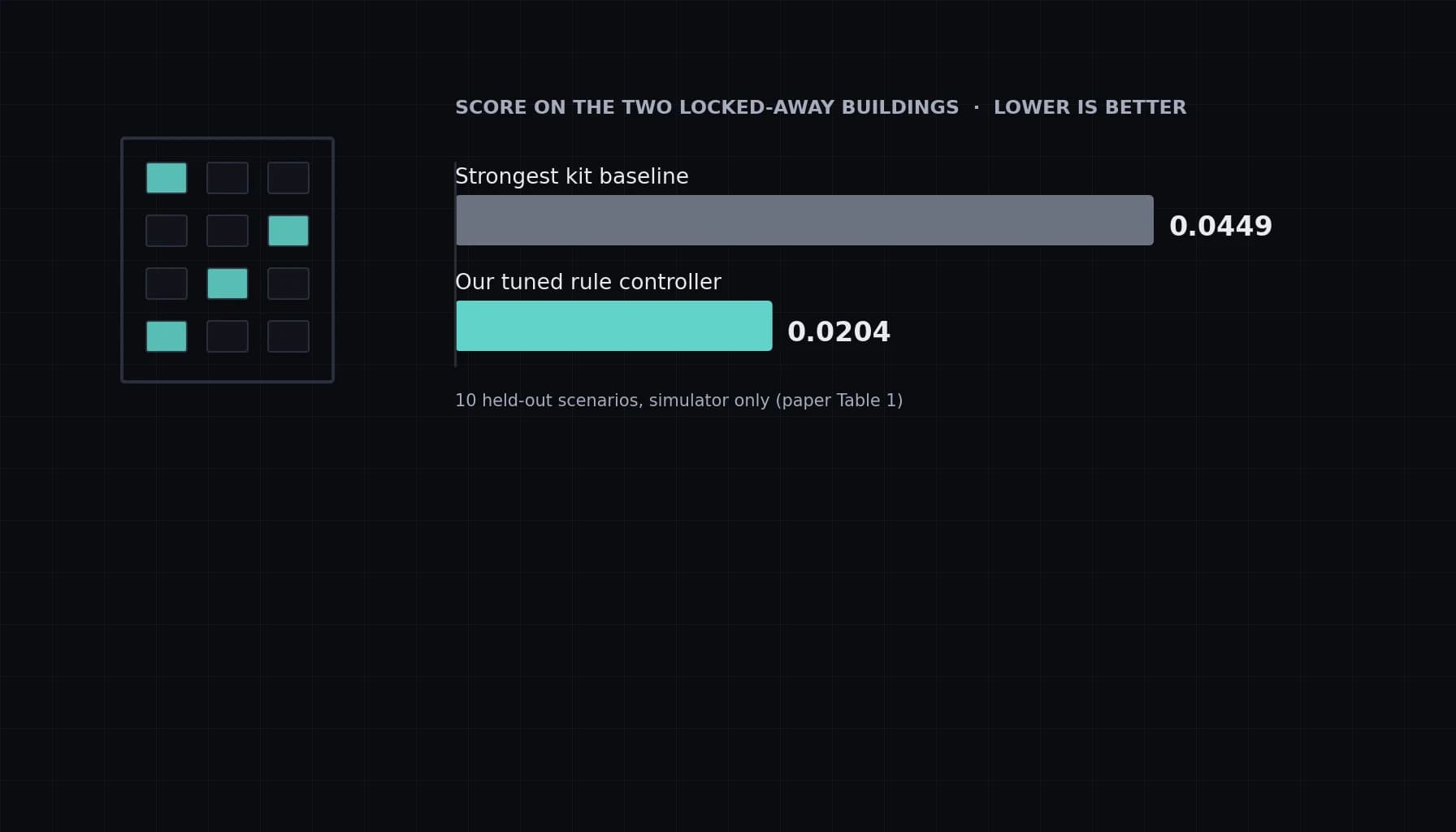
On the locked-away buildings, less than half the baseline's score. Across the 10 held-out building-and-weather combinations, the frozen controller scored 0.0204 against 0.0449 for pid_water, the strongest example controller in the kit (lower is better). It won all 10. Across all 30 practice combinations it scored 0.0279 against 0.0550 and won 27 of 30.
Comfort, cost and carbon all improved together. It was not saving energy by letting people get cold or hot. Compared with the baseline, comfort shortfall fell by 46 percent, energy cost by 58 percent and carbon by 50 percent.
| Controller | Held-out (10) | All 30 |
|---|---|---|
| Strongest kit baseline | 0.0449 | 0.0550 |
| Ours, hand-set | 0.0744 | 0.0729 |
| Ours, tuned and frozen | 0.0204 | 0.0279 |
Score = average cost per five-minute step, lower is better. "Held-out" = the two locked-away buildings. Simulator only.
The gain came from doing less. We expected the well-known energy features to matter: free cooling from outside air, night setback, adjusting the hot-water temperature, idling unused air handlers. Switching any one of them off changed the score by about 2 percent at most. What mattered were the gentle settings: smaller damper and valve moves, lower fan pressure, and no extra air or heat for a room that is already comfortable. In the first round of tuning, doubling the damper response made the score 34 percent worse, and doubling the reheat response made it 29 percent worse. Putting the room-level settings back to their hand-set values cost 32 percent, the air-handling settings 16 percent.
Best in the cold, mixed in the heat. The tuned controller beat the baseline at all five weather locations, but most of its advantage came from cold places such as Fairbanks and Denver. In hot climates some of the tuned settings did worse than the original hand-set ones: in Singapore, the hand-set room settings scored 0.0097 against 0.0235 for the tuned ones. One set of dials is a compromise between climates. A controller that adjusts to the climate is the obvious next step. We have not tried it yet, because tuning again on the same buildings would spoil the clean test.
A catch for everyone in the challenge. The kit ships reference scores for its example controllers. We could not reproduce them on the current kit: re-running pid_water gave 0.0550 instead of the shipped 0.0541, and only 4 of the 30 scenarios agreed within 0.1 percent. We traced this to a fix in the kit's simulator after those scores were made, and we reproduced the shipped numbers exactly on the older version. The lesson for other entrants: re-run every baseline on the same kit you test on.
The honest limit
The competition also scores every entry on hidden buildings and weather that nobody can see. There, our frozen controller scored 0.0391, rank 504 of 599 on November 7. The improvement we measured on the practice buildings has not shown up on the hidden set yet.
That is not a contradiction. Our two locked-away buildings come from the same generator as the four we tuned on, and the hidden buildings are different. So our result is evidence that the approach transfers between similar buildings. It is not proof that it transfers to any building, and the leaderboard says it does not yet. Everything here is also simulation only, not a real building.
Why this matters to ShrineTech
We take part in open challenges like this one to practise the habits we bring to client work: decide how a result will be tested before testing it, keep some data locked away, re-check the reference numbers instead of trusting them, and say plainly where a result stops. A controller that wins on the buildings it was tuned on is easy. Knowing how far that win really reaches is the useful part.
The paper, Doing Less Transfers: A Pre-Registered, Building-Held-Out Evaluation of a Tuned Rule Controller in the Smart Buildings Challenge, is under review at the NeurIPS 2026 Smart Buildings workshop. You can follow this and our other open-science work on our research page.
Quick answers
What is the Smart Buildings Challenge?
A NeurIPS 2026 competition that asks for one heating and cooling control policy that works on simulated buildings and weather it has never seen, with no per-building tuning.
How much better was the tuned controller?
On the two buildings we kept aside it scored 0.0204 against 0.0449 for the strongest example controller, winning all 10 combinations. On the competition's hidden test it ranked 504 of 599, so the gain has not carried over there yet.
Where did the gain come from?
Mostly from gentler settings: smaller damper and valve moves, lower fan pressure and no extra air or heat for rooms already in their comfort band. The well-known energy features each changed the score by about 2 percent at most.
Does this work in a real building?
We have not tested that. All results come from the challenge's simulator.

Comments (0)
Loading comments...